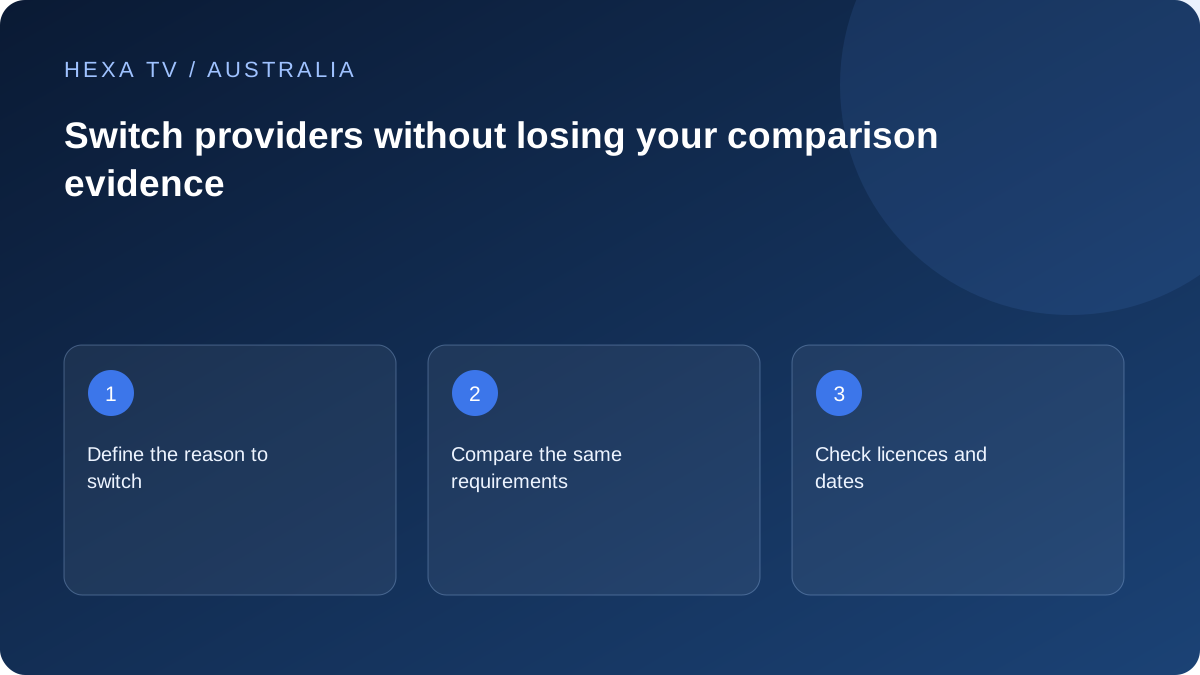
Define the improvement you expect
State why the Australian household is changing provider: a missing programme, unsuitable app, unexplained charge, insufficient concurrent sessions or a reproducible fault.
If the evidence points to a weak Wi-Fi path, fix or assess that independently. A different content account may inherit the same home-network problem.
Run a comparable replacement check
Use the same TV, viewing period and essentials list when evaluating the replacement. Record any differences in trial scope. Keep official local broadcaster options in the comparison so you know what extra value is being purchased.
Confirm whether the existing player accepts the new account and whether its licence transfers. Do not assume subscription credit or software purchases move between providers.
Protect the changeover
Read the old account's renewal terms and the new term's start rule. Save receipts and the old working configuration privately before changing household devices.
Set up one screen first. After successful verification, move the remaining permitted devices and revoke obsolete access through supported account controls.
Define the improvement in household terms
Choose a specific outcome: the required Australian programme becomes available, the main TV gains a supported app, two people can watch concurrently, or the total commitment better matches a short viewing period. A replacement decision is easier when the desired improvement is observable.
If the complaint is buffering only in a distant bedroom, examine the local network before assuming another content provider will fix it. If a single event is missing, investigate the current official viewing route. Those are different problems and may require different changes.
Create a before-and-after comparison
Use the existing screen, ordinary viewing time and the same type of authorised content wherever the two services permit it. Note any unavoidable difference in app, device or quality. A replacement that needs new equipment may still be suitable, but the extra cost and changed variable belong in the decision.
A trial result should describe exactly what was checked. It can demonstrate a usable remote or a particular available source, but cannot verify every advertised title or future event. Keep untested claims separate from the observed improvement.
| Current limitation | Replacement check | Decision evidence |
|---|---|---|
| Required local edition missing | Exact Australian catalogue and edition | Dated service answer and actual available item |
| Old TV app unsupported | Official model requirements or supported external route | Hardware and app combination |
| Too few simultaneous streams | Account allowance and household conditions | Permitted concurrent use |
| Playback issue in one room | Same-device wired or nearer-router comparison | Whether the local path changes the result |
| Unclear total cost | Current approved quote including extras | Full commitment rather than only monthly equivalent |
| Complicated daily use | Viewer completes ordinary navigation | Practical usability on the actual remote |
Budget the transition rather than just the new headline price
Account for any overlap between services, required player fees and a genuinely necessary streaming device. Do not assume the current service will credit unused time or that another provider can transfer the account. Those are terms to verify with the services involved.
For illustration, a fictional A$25 overlap and A$80 replacement commitment total A$105 before hardware. That cash requirement differs from a divided monthly headline. These are not HexaTV prices or real offers. Use the actual approved local quotes for the household's final comparison.
Keep the current route recoverable during evaluation
Save the existing supported configuration and recovery route privately. If the new service does not meet the essentials, the family should be able to return to the current app without reconstructing favourites and sign-in details from memory.
Do not send the old provider's credentials to a new provider to make migration easier. Use each service's own account process. If a player offers an export, determine whether it includes private URLs or tokens before placing it in a shared folder or attaching it to a support request.
Use a clear decision threshold
Mark each essential requirement as satisfied, unsatisfied or still unknown. Decide whether the replacement solves the actual reason for switching at an acceptable complete cost. A larger catalogue is not compensation for a missing essential programme unless the household consciously changes its requirement.
For reliability concerns, record the limits of the sample and keep the comparison conditions. One smooth afternoon cannot certify every evening, just as one failed item cannot condemn every source. Ask for unresolved facts instead of converting uncertainty into an optimistic score.
Separate cancellation from deleting an app
Use the existing service's documented process for cancellation or stopping renewal and retain the confirmation. Removing the app from a TV is a device action, not proof that the commercial arrangement has ended. Check the account state through the appropriate official route.
After choosing the replacement, rebuild only the household shortcuts that are useful. Confirm the main screen and any permitted secondary screen, required accessibility controls and the ordinary remote routine. Keep payment records and recovery details private, and remove obsolete device access through supported account controls.
Review the outcome after the initial changeover
Compare the new experience with the original requirement, not with a vague expectation that everything must improve. If the intended benefit is present, record the working setup. If it is absent, identify whether the unresolved part belongs to the provider, app, device or network.
This review also informs the next renewal. A short-term choice can remain short-term while facts are still being established. There is no need to extend the commitment simply because the migration work has already been done; evaluate the next payment against the household's current needs.