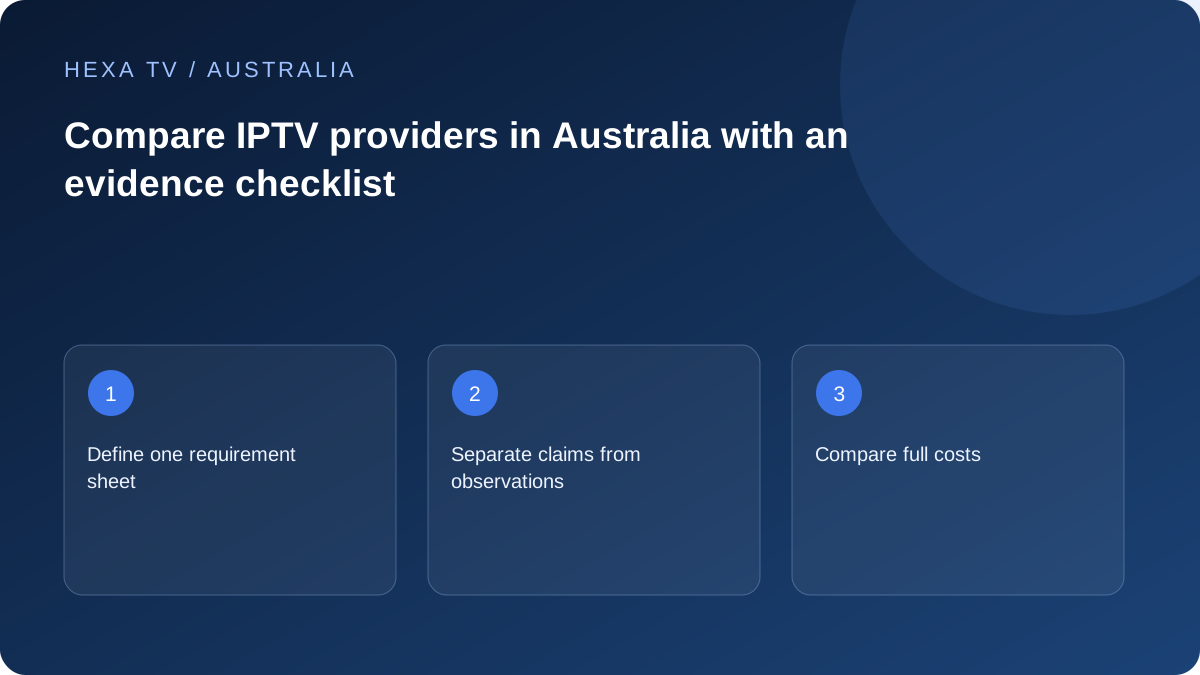
Compare the same Australian viewing job
Start with the programmes the household would otherwise watch through official broadcaster services or existing subscriptions. Identify what an additional paid plan needs to provide and which television must run it.
Give each candidate the same essentials list. A provider that answers a different question with a channel count has not established fit.
Use four evidence columns
For each requirement, record the current written answer, a limited observation if tested, the date and the remaining uncertainty. Keep marketing statements in their own column. Do not combine them into a made-up reliability percentage.
For example, an official app listing can support platform availability, while a trial can support one observed playback result. Neither alone establishes an entire territorial catalogue.
Compare currencies and commitments explicitly
HexaTV prices and payments are in euros. Keep that currency clear when comparing Australian competitor advertisements. Record the actual billing currency, term, streams, player fee and renewal conditions for each offer.
If a final foreign-currency charge is proposed, make that a clear comparison attribute rather than inventing an exchange-rate total.
Ask about support at the time you need it
Use the Australian timezone in the question and ask for the actual support window. Check whether help covers the content account, player software or device setup. A global support slogan is not a measured response commitment.
This page is a comparison method, not a hands-on ranking. No service-quality tests or rights verification have been completed for the candidate offers.
Use an Australian requirement matrix
Start with the exact programmes and features the household would otherwise obtain through official broadcaster services or existing subscriptions. Record the intended device and simultaneous sessions beside each requirement. This defines the job a new paid account must do.
Keep the matrix unchanged while visiting providers. A website with a huge catalogue total should not distract from an unanswered question about the one programme or accessibility feature that matters. A requirement can be essential even when it is not prominent in the advertisement.
Evidence categories that should stay separate
A transparent comparison identifies the source and the limits of each answer rather than presenting every claim as verified.
| Category | Example of useful evidence | Limit |
|---|---|---|
| Commercial scope | A current written quote and terms | Not a performance test |
| Software support | Exact-model official app information | Not a complete source-format guarantee |
| Catalogue claim | Dated answer for the Australian account | Not permanent availability |
| Observed behaviour | A labelled limited trial session | Not annual uptime |
| Official viewing route | Current broadcaster or rights-holder information | Not third-party redistribution proof |
| Reported experience | A user's specific account of a fault | Not a representative success rate |
Read the observed Australian sample proportionately
The research receipt observed AussieStream advertising one-connection plans in AUD, with A$30, A$49 and A$80 shown for three, six and twelve months. Its public pages also discussed device setup and NBN-related viewing questions. These are sales-page observations, not verified service quality or rights.
Only a small local competitor sample was inspected. It is insufficient for a claim that every Australian provider was evaluated or that one was independently ranked best. Recheck the actual current quote and terms directly when a purchase is being considered.
Compare full outlay in the actual currency
Use the same term and concurrent-session requirement for every quote. Record the payable total and currency, separate player cost, any necessary hardware, renewal conditions and what activates the term.
Do not compare an AUD advertisement with a HexaTV EUR price by number alone. The HexaTV charge is in euros; your bank may apply conversion or fees. Keep any unquoted conversion cost separate from the subscription total.
Work an illustrative decision without pretending it is research
Consider a hypothetical household whose main TV supports Player A but not Player B. An account advertised at a lower subscription price may require different hardware and another licence. Obtain those actual costs before calling it cheaper.
If the higher-priced alternative lacks the essential subtitle track, the completed cost comparison still does not make it suitable. The example illustrates how device, feature and money requirements interact; it is not a factual comparison of the sampled provider or any named competitor.
Ask for a meaningful catalogue answer
Name the exact programme, live event or language requirement, not only a broad category such as sport. Ask which Australian account scope applies and whether live, replay or on-demand access is intended.
A guide entry or familiar logo is not enough. Keep the official broadcaster or rights-holder route in the comparison and do not infer that an unrelated provider has distribution authority because the source can be named.
Evaluate device fit across the whole household
Record the exact model, operating system, app publisher and login method. Check the genuine Australian app availability. A successful phone app does not demonstrate a television interface or remote support.
Include independent services the household uses, such as official local broadcaster apps. If a new box is required, it should be assessed against that complete app set. Buying hardware for one account can be poor value if it removes another everyday viewing route.
Define support in Australian time
Ask for actual hours, timezone and responsibility. A provider may support the content account while the app publisher handles installation or crashes. A listed contact method is not proof of an immediate response or local staffing.
If a response-time claim is important, ask what it covers and whether the basis is documented. Do not manufacture a support score from one unanswered message or a few online comments. Keep direct observations dated and limited.
Inspect the rules for changes
A replacement television, a move, another active screen and travel are different events. Request the relevant account rules and any cost for each likely change. A general multi-device label does not settle those questions.
Check the player licence separately from the content subscription. Account recovery should not depend on sharing secrets in a public support forum, and a saved application does not necessarily preserve a server-side entitlement after expiry.
Test candidates under comparable conditions
Where authorised evaluations exist, use the same device, usual viewing period and essential tasks. Record differences in trial scope. A restricted demonstration and a full account should not receive the same completeness status without qualification.
If a fault appears, preserve a working control and change one condition. Keep network evidence separate from account-limit messages. A test that accidentally exceeds the permitted sessions can create a false negative.
Make unknowns visible in the final decision
Use met, unmet and unconfirmed beside each essential requirement, with the date and supporting source. A low price cannot erase an unconfirmed critical item. If you choose to accept a limitation, write down what it is rather than renaming it a verified feature.
A numeric ranking is not required for a clear choice. The result may be to retain an official route, solve a device issue first or obtain a more precise quote. This page supplies a comparison process, not a claim of hands-on review or an endorsement.
Refresh the rows that changed
Revisit the affected evidence when prices, app support, household needs or the desired event change. Preserve the old receipt as historical information, then put the new offer beside it.
This prevents a previous market observation from becoming an inaccurate current recommendation. The date of a comparison is part of its usefulness, particularly where a subscription's catalogue and supported hardware can evolve.